




Mumbai’s “Pedestrian First” Push: Will It Actually Make the City Easier for Wheelchair Users?
Mumbai is a city built around movement. Millions of people walk to railway stations, catch buses, cross busy roads and navigate crowded footpaths every day.
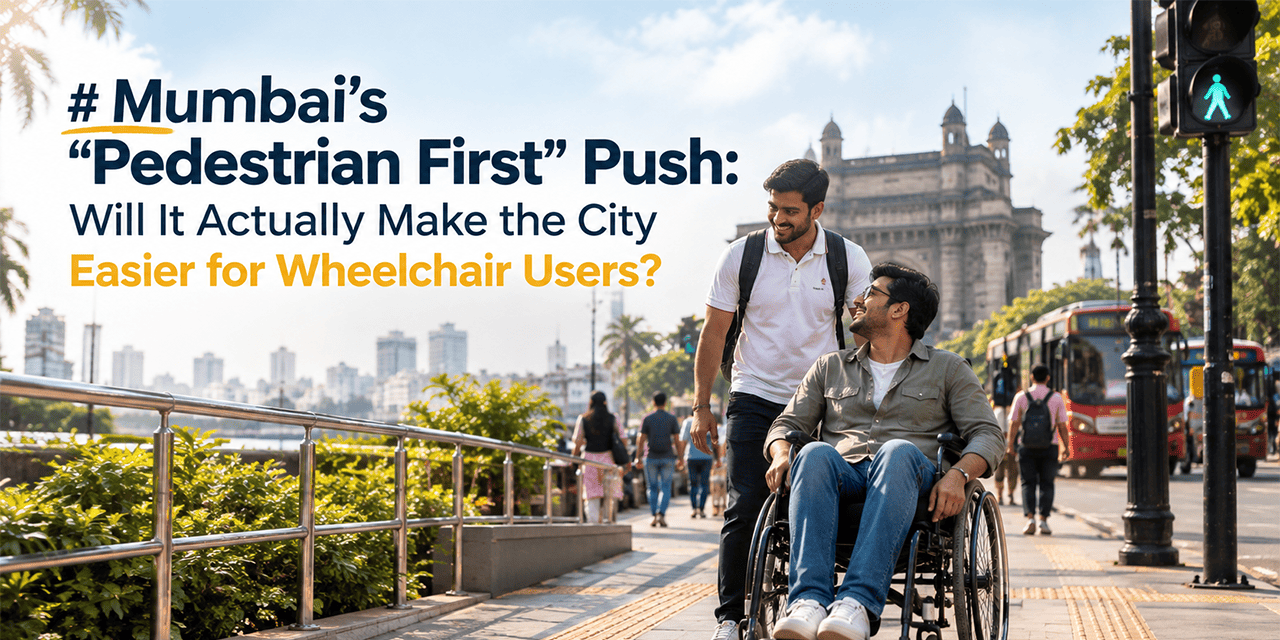
But what happens when walking is not an option?
For a wheelchair user, senior citizen with limited mobility, or someone recovering from an injury, a journey that looks simple on Google Maps can become a complicated obstacle course. A parked scooter, a broken kerb, a narrow footpath or a food stall occupying the pavement can be enough to turn a short journey into a major challenge.
That is why Mumbai’s renewed “Pedestrian First” campaign is worth paying attention to.
What is Mumbai’s Pedestrian First campaign?
The Brihanmumbai Municipal Corporation (BMC) has been working to reclaim footpaths from unauthorised hawkers, parked vehicles, encroachments and other obstructions.
In September 2026, the BMC said around 246 km of footpaths had been made obstruction-free, with action taken at 1,711 locations across Mumbai.
The campaign is also moving beyond simply removing obstacles. The BMC has announced plans to redesign footpaths on 30 roads across areas including Ghatkopar, Bhandup, Kanjurmarg, Nahur and Mulund, with the aim of creating better pedestrian infrastructure.
On paper, that sounds like a significant improvement.
But there is an important question:
Will these changes make Mumbai easier to navigate for people with restricted mobility?
A clear footpath is not automatically an accessible footpath
For someone walking, having two metres of unobstructed pavement can already make a big difference.
For someone using a wheelchair, accessibility involves much more.
The surface needs to be reasonably level. Kerbs need suitable slopes. There needs to be enough space to manoeuvre. Bollards should not be positioned so closely that a wheelchair cannot pass. Pedestrians should be protected from moving traffic, and routes should connect properly with crossings, public transport and building entrances.
These are not new ideas.
BMC’s Universal Footpath Policy, finalised in 2023, includes provisions such as tactile paving, wheelchair-friendly bollard spacing, kerb slopes and safety measures between pavements and carriageways.
Yet a June 2026 report by Mid-Day found that several accessibility features outlined in the policy were still largely absent from Mumbai’s footpaths.
That creates a gap between having an accessibility policy and experiencing accessibility on the street.
The real problem is often the last few metres
Imagine someone travelling from home to a Mumbai Metro station.
The Metro station may have a lift.
The train may have provisions for accessibility.
But what happens before reaching the station?
Perhaps the footpath suddenly becomes too narrow. A parked motorcycle blocks the route. There is a high kerb at the crossing. The only alternative is to move onto the road.
This is where accessibility can break down.
A journey is only as accessible as its least accessible section.
Recent reporting by Hindustan Times highlighted this problem during a ground check of several Mumbai footpaths. At some locations, hawker stalls, parked vehicles, garages, pipes and other obstructions left only a fraction of the original footpath usable.
For a wheelchair user, that is not simply inconvenient.
It can mean having to enter the road.
Mumbai needs to think beyond the ramp
The conversation around accessibility often starts and ends with ramps.
But a ramp at a building entrance cannot solve an inaccessible journey outside the building.
True wheelchair accessibility in Mumbai has to connect the entire route:
Home - Footpath - Crossing - Public - transport - Station - Destination
If even one section is blocked, unsafe or impossible to navigate independently, the journey becomes difficult.
This is why the Pedestrian First campaign could become more than a beautification or traffic-management exercise. If pedestrian infrastructure is redesigned with universal accessibility in mind, improvements can benefit wheelchair users, elderly people, people with temporary injuries, parents with prams and anyone who finds Mumbai’s streets difficult to navigate.
What would a genuinely accessible Mumbai look like?
It would not necessarily mean building something complicated everywhere.
It could mean consistent footpath levels, properly designed kerb ramps, unobstructed walking space, safer crossings, accessible public transport connections and better maintenance.
Most importantly, accessibility needs to be considered before infrastructure is built, rather than treated as an additional feature later.
Mumbai has already recognised the need for better pedestrian infrastructure.
The next step is making sure that “pedestrian first” includes every pedestrian.
When infrastructure isn't enough, mobility support still matters
City-wide improvements take time.
Until then, families often have to plan individual journeys around the realities of Mumbai’s streets. An elderly parent may need assistance getting to an appointment. A wheelchair user may need a companion during travel. Someone recovering from an injury may need help navigating a station or reaching a destination safely.
This is where services such as MobiCrew’s mobility and companion support can help families arrange practical assistance when they cannot be there themselves.
The bigger goal, however, should remain clear.
Mumbai should not just be a city where people can technically get from one place to another.
It should be a city where more people can make that journey safely, independently and with dignity.
Related
-
Saying Yes More Often: How Reliable Mobility Support Changes Daily Life
-
When You Can't Be There: Using a Mobile App to Arrange Care for Parents
-

Buy Vissco Commode Wheelchair Online: Features, Benefits and Best Deals
-
Book Wheelchair Online in Mumbai: Fast, Affordable & Hassle-Free with MobiCrew
-
Elderly Care Services Offered by Modern Health Providers
Get more caregiving guidance like this
Add MobiCrew as a preferred source to see our latest eldercare and mobility articles first in Google.
Add as preferred source