




Beyond Ramps: The Everyday Accessibility Challenges Faced by Wheelchair Users in Mumbai
Absolutely. I’d make the article links visible in the text itself, rather than only using citation markers. I also checked the current Mumbai reporting again, so the links below point to the actual articles.
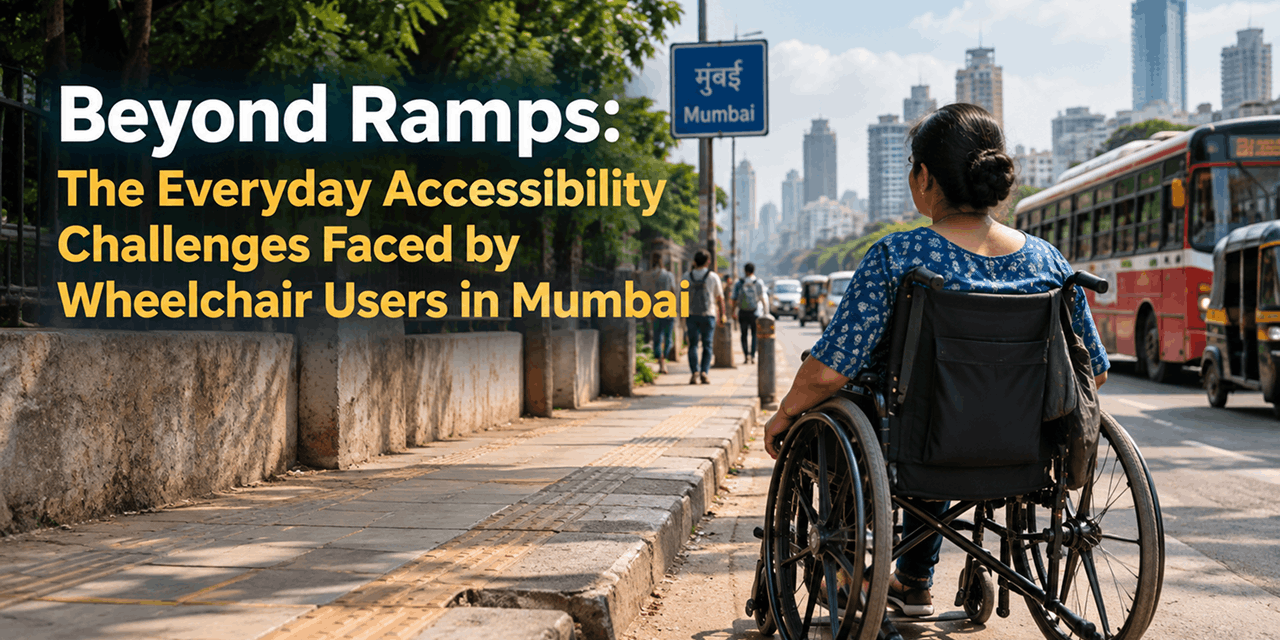
Mumbai is a city built around movement. Trains, buses, taxis, crowded streets and endless footpaths keep millions of people moving every day. But for wheelchair users, getting from one place to another can involve obstacles that most people never have to think about.
Accessibility is not simply about whether a building has a ramp. It begins much earlier: getting from home to the road, navigating the footpath, crossing the street, reaching public transport and finally entering the destination.
And Mumbai still has work to do.
The problem often starts on the footpath
For a wheelchair user, a footpath is an essential part of the journey. It connects homes with railway stations, hospitals, shops, offices and public spaces.
Yet Mumbai's footpaths continue to create accessibility problems.
A June 2026 report by Mid-Day, “Mumbai footpaths still inaccessible despite BMC accessibility policy”, reported that key accessibility features under the BMC's Universal Footpath Policy remained largely absent two years after the policy was introduced. The policy includes provisions such as kerb slopes, appropriate spacing between bollards and tactile paving.(Mid-Day)
For someone using a wheelchair, a badly positioned bollard or a high kerb is not a minor inconvenience. It can completely block the route.
And the problems are not limited to one neighbourhood.
A real-life example: Five Gardens
One of the clearest examples comes from Mumbai's Five Gardens in Matunga.
In July 2025, Hindustan Times reported on a disability audit conducted by Access to Hope. The audit identified unusable or missing ramps, uneven footpaths, steep slopes and obstructions, including bus stops, tree guards, poles, signboards and hawkers.
You can read the full report here: Hindustan Times: “Five Gardens fails disability audit”
The report also documented the experience of wheelchair user Jasmina Khanna, who described the uneven footpaths as extremely difficult to navigate.(Hindustan Times)
This is an important reminder that accessibility is about much more than putting a ramp at the entrance.
A ramp that leads to an uneven path does not solve the problem.
Mumbai is trying to improve its footpaths
There are also developments in the other direction.
The BMC has been working on improving pedestrian infrastructure, including its Universal Footpath Policy and more recent footpath redevelopment projects.
In September 2026, The Indian Express reported that the BMC had started work to redesign footpaths on 30 roads across Ghatkopar, Bhandup, Kanjurmarg, Nahur and Mulund. The areas include markets, railway stations, schools and bus stops.
Read the current report here: The Indian Express: “Mumbai never sleeps, but now it will walk better”
The project aims to reclaim and redesign existing footpaths to improve walkability.(The Indian Express)
There have also been plans for larger-scale footpath redevelopment. Earlier in 2026, The Indian Express reported on the BMC's proposed pilot project for redesigning footpaths at high-footfall locations according to its Universal Footpath Policy.
The Indian Express: “BMC’s ambitious footpath remodelling plan stuck in limbo”
The challenge is making sure that accessibility remains part of the implementation, not just the policy.
Accessibility does not end at public transport
Mumbai's transport network is another important part of the conversation.
A person may be able to enter an accessible railway or Metro station, but what happens before reaching the station?
What happens after getting off?
A 2026 study of Mumbai Metro Line 3, reported by Hindustan Times, highlighted issues including long staircases, inadequate escalators, wayfinding problems and poor last-mile connectivity.
Hindustan Times: “Long stairs, poor last-mile links hamper Metro 3”
This is why accessibility has to be considered as an entire journey rather than as an individual building or station.
So what would make Mumbai more accessible?
There isn't one single solution.
Some of the practical changes include:
• Continuous and obstruction-free footpaths
• Properly designed kerb ramps
• Sufficient space between bollards
• Smooth, level surfaces
• Accessible public toilets
• Step-free entrances
• Reliable lifts at transport hubs
• Clear signage and wayfinding
• Better last-mile transport
• Regular accessibility audits
• Proper maintenance after construction
The BMC's own Universal Footpath Policy already identifies several of these requirements. The challenge is ensuring that they are implemented consistently across the city.
What can families do in the meantime?
Large infrastructure changes take time. But families planning a journey for a wheelchair user can reduce uncertainty by checking the route beforehand.
Instead of asking only, “Is this place wheelchair accessible?”, ask more specific questions:
Is there a step-free entrance?
Is the route from the drop-off point accessible?
Are there accessible toilets?
Can a wheelchair actually move along the surrounding footpath?
Is assistance available if something unexpected happens?
For longer journeys, having a companion can also make a significant practical difference.
This is where MobiCrew can help.
MobiCrew provides mobility and companion support designed to help people travel and manage everyday journeys with additional assistance.
You can explore MobiCrew's mobility services to see the available options, or visit MobiCrew.com to learn more about the services.
Accessibility is about more than ramps
Mumbai has already started taking steps towards better pedestrian infrastructure. New projects, accessibility policies and audits show that the conversation is moving forward.
But the real test is what happens on the ground.
A wheelchair user should not have to find out halfway through a journey that a footpath suddenly ends, a bollard blocks the way or an entrance has an unexpected step.
True accessibility means being able to leave home, travel safely, reach your destination and return without having to depend on luck.
A ramp is part of accessibility.
It is not the whole solution.
Related
-
The Future of In-Home Care: How Apps Are Making Elderly Care More Accessible
-
Can AI Actually Make Mumbai More Accessible for Disabled People?
-
Things to Check Before Hiring a Caregiver Agency in Mumbai
-
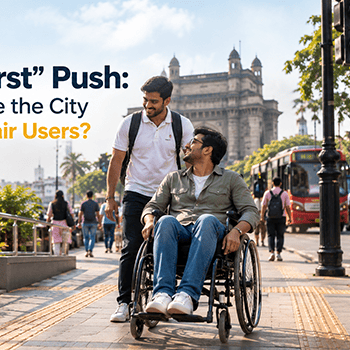
Mumbai’s “Pedestrian First” Push: Will It Actually Make the City Easier for Wheelchair Users?
-
Best Home Help Care Services in Mumbai for Elderly Support
Get more caregiving guidance like this
Add MobiCrew as a preferred source to see our latest eldercare and mobility articles first in Google.
Add as preferred source