




Can AI Actually Make Mumbai More Accessible for Disabled People?
Mumbai is getting smarter.
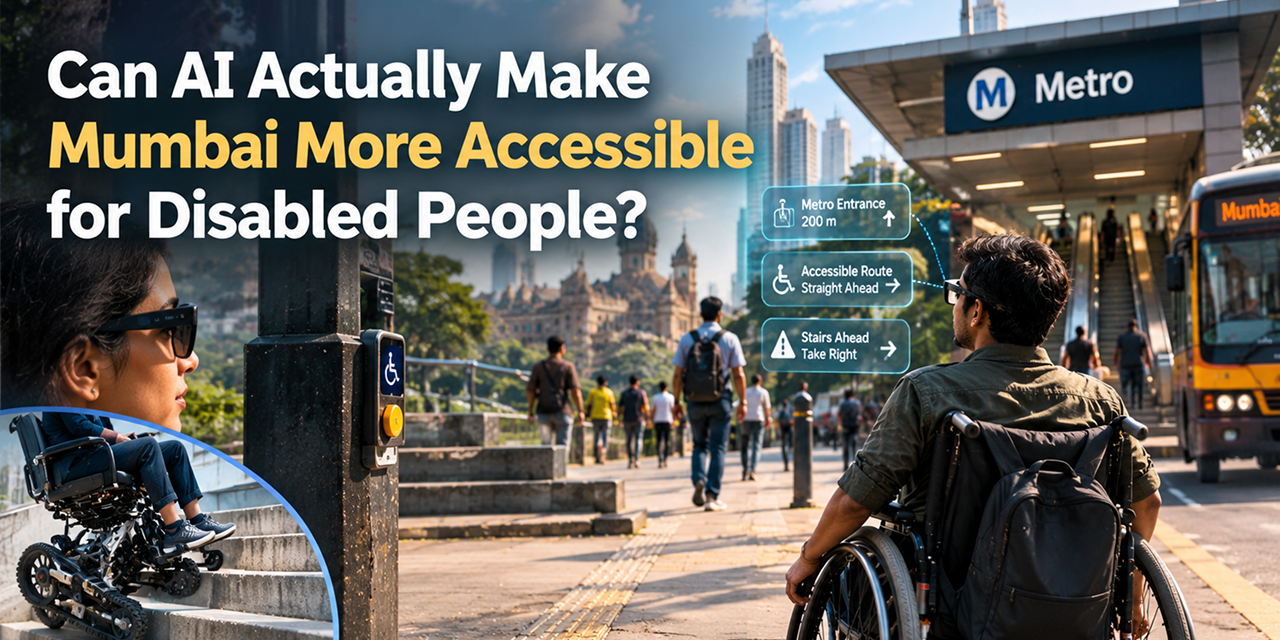
From AI-powered public services to intelligent transport systems, artificial intelligence is increasingly becoming part of how the city works. But there is another question worth asking: can AI make Mumbai more accessible for people with disabilities?
The answer could be yes, but probably not in the way most people imagine.
AI cannot repair a broken footpath or install a lift in a railway station. What it can do is help people navigate barriers, understand their surroundings, access information and use assistive technology in ways that were difficult or impossible before.
And some of those developments are already happening.
AI Is Moving Into Assistive Technology
In May 2026, AI-powered smart glasses were distributed to visually impaired people at an empowerment event in Malad, Mumbai. The glasses were presented as assistive technology intended to support greater independence.
This is an important shift.
For someone with a visual impairment, technology that can recognise objects, read information or describe surroundings could potentially turn a smartphone or wearable device into an everyday mobility assistant.
There are already Indian AI tools working in this direction.
For example, Audivision, an AI-powered accessibility application, can recognise text, identify objects and signs, assist with wayfinding and provide spoken information. Its examples include identifying public toilets, reading documents and recognising metro station signs.
That kind of technology could become particularly useful in a city like Mumbai, where navigating an unfamiliar street or transport interchange can be challenging.
What If Your Phone Could “See” the Street for You?
Imagine approaching a busy Mumbai intersection.
Instead of relying entirely on another person, an AI-enabled device could potentially identify a pedestrian crossing, read a road sign, recognise an obstruction or provide spoken information about what is ahead.
For wheelchair users, similar technology could eventually help identify whether a route contains stairs, steep slopes, narrow passages or other potential obstacles.
The technology does not need to physically move the wheelchair to be useful.
Sometimes, better information can create more independence.
Mumbai Is Also Seeing AI-Powered Wheelchair Innovation
One of the most interesting developments has come from Mumbai itself.
In March 2026, The Indian Express reported on a VJTI graduate who developed an AI-enabled robotic wheelchair capable of climbing stairs and navigating uneven terrain.
The prototype was developed after the engineer experienced accessibility barriers personally. It combines robotics and assistive technology to tackle one of the biggest problems wheelchair users face: infrastructure that was never designed for them.
This is particularly relevant to Mumbai.
Even if a building has a ramp, the route to reach it might include an uneven pavement, a staircase, a broken kerb or another obstacle.
A wheelchair that can adapt to difficult terrain could therefore change what is physically possible for its user.
But there is an important limitation.
Technology should not become an excuse for poor infrastructure.
AI Can't Fix an Inaccessible City
This is where the conversation becomes more complicated.
Suppose an AI application tells a wheelchair user that the nearest accessible entrance is 300 metres away.
That information is useful.
But what if the pavement between the user and that entrance is blocked by parked vehicles?
What if the kerb has no proper ramp?
What if the lift at the station is not working?
What if the supposedly accessible route ends at a staircase?
AI can identify problems, help users plan around them and potentially provide alternatives.
But it cannot replace accessible urban design.
Mumbai still needs better footpaths, crossings, public transport connections, ramps, lifts and last-mile infrastructure.
The Future Could Be AI + Accessible Infrastructure
The most useful future may not be about choosing between technology and infrastructure.
It could be about combining both.
Imagine a Mumbai where:
- AI applications identify accessible routes in real time.
- Wheelchair users can receive information about obstacles before starting a journey.
- Public transport apps show which entrances and lifts are operational.
- Cameras and sensors identify blocked pedestrian routes.
- AI-powered assistive devices help visually impaired people understand their surroundings.
- Wheelchairs become more capable of navigating difficult terrain.
- Accessibility information is available in multiple languages and formats.
Some pieces of this future are already being developed.
In 2025, India's Department of Empowerment of Persons with Disabilities launched initiatives including Mission AI Accessibility, an AI programme focused on assistive technologies, and a National Disability Support AI Chatbot.
In 2026, C-DAC Mumbai also launched SATYA AURA, a browser-based accessibility solution designed to support people with visual, cognitive, motor, auditory, neurological and age-related accessibility needs.
The technology is moving quickly.
The bigger challenge is making sure it reaches the people who actually need it.
AI Should Give People More Independence, Not More Dependence
For a person with a disability, accessibility is ultimately about choice.
Can I travel somewhere without constantly worrying about whether I will be able to enter?
Can I find the correct route?
Can I understand the information around me?
Can I ask for assistance when I need it?
AI has the potential to make some of these questions easier to answer.
But the goal should never be to build a city where disabled people need advanced technology just to survive ordinary infrastructure.
The goal should be a Mumbai where accessible infrastructure and intelligent technology work together.
AI can become another tool for mobility, independence and inclusion.
But the smartest city is not necessarily the one with the most AI.
It is the one where more people can move through it freely.
Related
-
How to Choose the Right Caretaker Agency in Mumbai
-
24/7 Health Service Providers in Mumbai: Emergency Care When You Need It
-
Buy Vissco Commode Wheelchair Online: Features, Benefits and Best Deals
-
Wheelchair Users and Ganesh Chaturthi: How Inclusive Are Mumbai’s Famous Pandals?
-
How to Find Reliable Caretaker Services in Mumbai for Elderly Care
Get more caregiving guidance like this
Add MobiCrew as a preferred source to see our latest eldercare and mobility articles first in Google.
Add as preferred source