




Accessibility Is More Than Ramps: What Makes a Business Welcoming to Customers?
A restaurant adds a wheelchair ramp at its entrance. Says it is accessible. But what happens when a person in a wheelchair arrives and finds the tables are too close the washroom has a door or the staff do not know how to help?
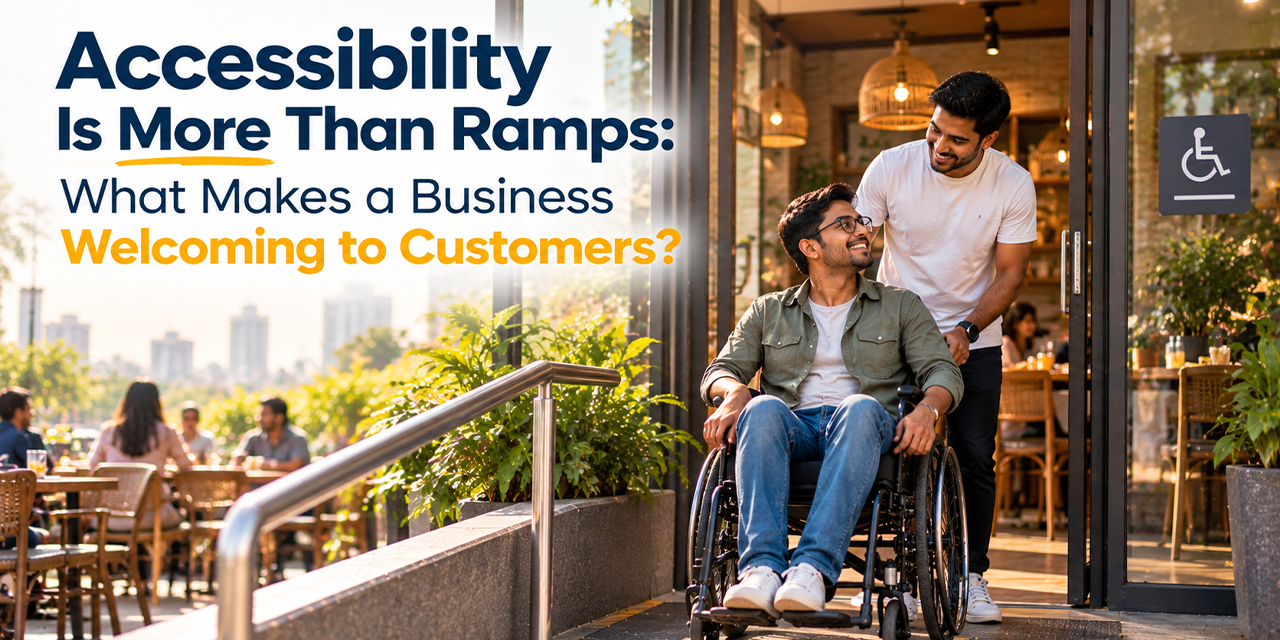
This may be a problem in how businesses think about disability accessibility in India. Accessibility is usually seen as a feature instead of a full customer experience.
For people with disabilities and those with limited mobility, a truly accessible business is one where they can enter, move around, use the facilities, and enjoy the service without unnecessary difficulties.
So what does that really mean for businesses in Mumbai?
1. Accessibility Starts Before the Customer Arrives
Imagine planning a dinner with friends and having to call three restaurants to find out if you can enter in a wheelchair.
For people with disabilities, this is part of everyday life.
Businesses can make this easier by providing accessibility information on their websites, Google Business Profiles, and booking websites.
Useful information includes whether the place has step-free access, accessible toilets, lifts, suitable parking, and enough space for a wheelchair to move around.
Photos of the entrance and facilities can also help customers decide if the place is right for them.
An accessible customer experience starts when someone is deciding if they can visit, not when they get to the door.
2. A Ramp Is the Start
Putting in a ramp is a good step, but it does not automatically make a building wheelchair-friendly.
A ramp that is too steep, blocked by cars, or positioned next to a difficult-to-open door might still be hard or dangerous to use.
For businesses in Mumbai, the whole entrance needs to be considered.
Can someone get to the entrance from the sidewalk? Is there space to turn a wheelchair? Can the door open easily? Is the path free from steps?
These details matter a lot in Mumbai, where busy sidewalks, uneven ground, and limited parking can make reaching a business difficult.
Businesses should check accessibility from the practical drop-off point, not just from the entrance itself.
3. Customers Should Be Able to Move on Their Own
Getting through the door means little if a customer cannot move comfortably inside.
Think of a clothing store with narrow aisles, a supermarket with displays blocking the way, or a café where the tables leave no space to move between them.
These setups might be annoying for some people, but they can make the space unusable for someone in a wheelchair.
Businesses can improve wheelchair accessibility by keeping paths clear, arranging furniture appropriately, and making sure important service areas are reachable.
Counters, payment areas, seating, and changing rooms should also be considered.
The goal is to let customers use the service as independently as possible, without having to ask for help with everything.
4. Accessible Toilets Are Not a Luxury
A customer might be able to enter, sit down, and enjoy a meal but still be unable to use the toilet.
This is one of the overlooked parts of accessibility.
An accessible toilet needs enough space to move, appropriate grab bars, a suitable door, and fixtures that can be reached and used safely.
Just putting a wheelchair symbol on a washroom does not make it accessible.
Businesses should also make sure that accessible toilets are kept clean and are not used for storage.
For people planning to stay for a while, especially older adults and those with mobility issues, knowing that a usable toilet is available can make the difference between visiting and staying away.
5. Staff Training Can Make or Break the Experience
Physical buildings are important, but how employees treat disabled customers is just as important.
Imagine a person in a wheelchair entering a restaurant and the staff speaking to their friend instead of addressing them directly.
Or imagine a customer with limited mobility being rushed while trying to pay.
These situations can make someone feel unwelcome, even if the place has accessibility features.
Employees should know how to offer help appropriately, speak directly to the customer, and avoid assuming what someone can or cannot do.
A simple question like "Would you like any help?" is often better than jumping in immediately.
Staff should also know where accessible facilities are and how to respond when someone asks for support.
Good accessibility is not about treating customers differently. It is about providing the same quality of service to everyone.
6. Accessibility Is Also a Business Opportunity
Some businesses see accessibility improvements as a cost.
An inaccessible place might be losing more customers than its owners realise.
India's 2011 Census counted about 26.8 million people with disabilities. This historical figure does not include everyone who experiences injuries, age-related mobility issues, or other accessibility challenges.
The impact goes beyond one person.
A wheelchair user visiting a restaurant might come with friends or family. An older person might be accompanied by children or grandchildren. If a place is difficult to access, the whole group might choose to go elsewhere.
For restaurants, shopping centres, entertainment venues, and other customer-facing businesses, accessibility can influence customer satisfaction, repeat visits, and word-of-mouth recommendations.
Making a business more accessible is not just about helping one person. It can improve the experience for an entire group.
7. What Does Indian Law Say About Accessibility?
Accessibility is not just about customer service.
India's Rights of Persons with Disabilities Act, 2016, establishes a framework for accessibility, equal opportunity, and protection against discrimination.
The law includes provisions relating to accessibility in buildings, transportation, and information and communication technology.
Businesses should also understand the accessibility standards, building regulations, and requirements applicable to their premises.
Meeting the minimum legal requirements should not be the only goal.
A business may meet some requirements and still make the customer experience difficult.
The important question is whether a person with a disability can actually use the business's services comfortably, safely, and with respect.
8. How MobiCrew Helps Close the Accessibility Gap
Even when a business has worked hard to improve accessibility, getting around Mumbai can still be challenging for people with limited mobility.
Travelling from home to a restaurant, moving through a shopping centre, or attending an event might require additional assistance.
This is where MobiCrew's mobility and companion services can help.
MobiCrew offers mobility and companion-care support for people who need assistance during outings, appointments, shopping trips, and everyday activities.
For customers, this support can make visiting places in Mumbai easier.
For businesses and event venues, understanding how mobility companions assist customers can also help create a more welcoming environment for people who visit with support.
Learn more about MobiCrew's services.
Companion assistance should complement accessible buildings, not replace a business's responsibility to make its premises usable.
Accessibility Should Be Part of the Whole Experience
A ramp might help someone enter a building, but it does not guarantee that they will feel welcome once they are inside.
Real accessibility covers every step of the customer journey, from finding information and booking to entering, moving around, using the facilities, communicating with staff, and leaving safely.
For businesses in Mumbai, making a place more accessible does not always require major changes. Sometimes it starts with clearing obstacles, moving furniture, training staff, or providing accurate accessibility information.
The key is to see accessibility from the customer's point of view.
A business that truly welcomes people does not just let customers with disabilities enter. It creates an environment where they can participate, make choices, and enjoy the experience with the same respect and freedom as everyone else.
Related
-
Book Wheelchair Online in Mumbai: Fast, Affordable & Hassle-Free with MobiCrew
-

Top Qualities to Look for When Hiring a Care Taker in Mumbai for Post-Surgery Recovery
-
Things to Check Before Hiring a Caregiver Agency in Mumbai
-

How to Buy a Folding Electric Wheelchair That Fits Your Lifestyle and Budget
-

Long Distance Caregiver for Parents in Mumbai
Get more caregiving guidance like this
Add MobiCrew as a preferred source to see our latest eldercare and mobility articles first in Google.
Add as preferred source