




What Your Father Won't Ask For But Needs Right Now
There's a particular kind of silence that settles over a home when a father gets older.
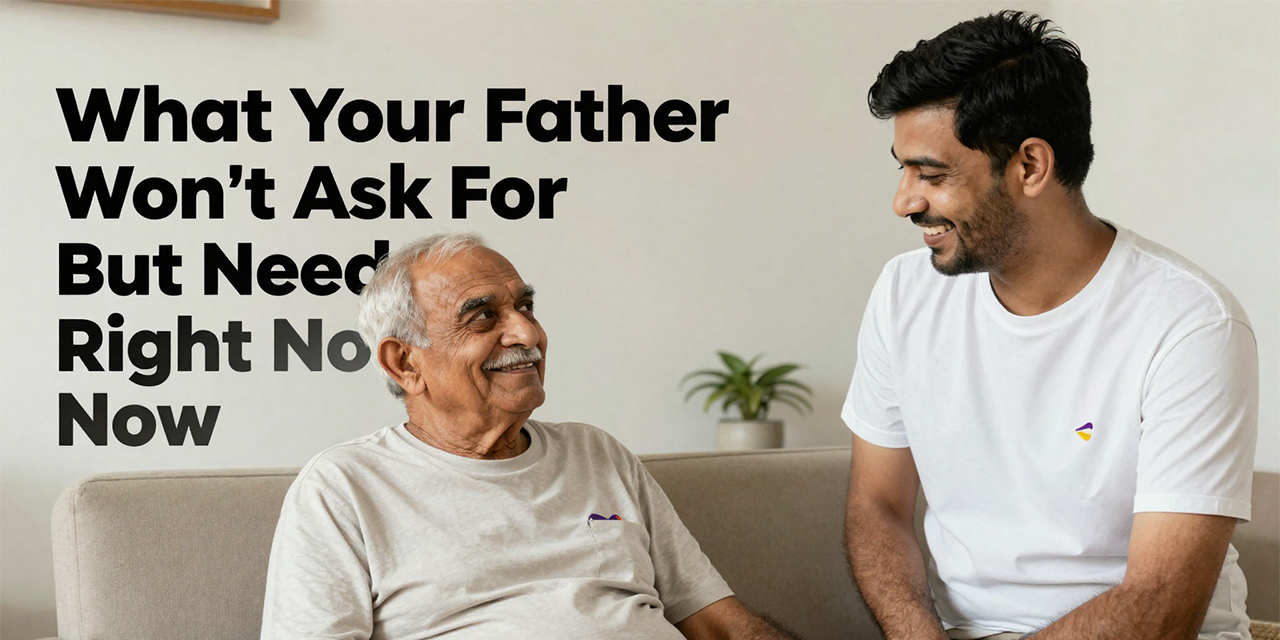
He doesn't complain. He doesn't ask. He insists he's fine when you call, brushes off your concern with a joke, and tells you not to make a fuss. But you notice things. The walk is slower. The stairs take longer. He's stopped going to the park in the mornings. He doesn't mention his friends as much. And when you visit, you realise the house is quieter than it used to be.
This is the reality of ageing for thousands of fathers across Mumbai. They were raised in a generation that equated asking for help with weakness. They spent their lives being the ones others leaned on. And now, when the tables are beginning to turn, they find it almost impossible to say: I need support.
But needing it and not asking for it doesn't mean the need isn't real.
What He Actually Needs — But Won't Say
Physical Safety at Home and Outdoors
Falls are the single most significant health risk for men over 65 in India. According to the Indian Journal of Orthopaedics, hip fractures resulting from falls in elderly men are associated with a dramatically increased risk of serious complications within the first year. And most falls happen during ordinary moments — getting up from a chair, navigating to the bathroom at night, stepping off a kerb.
Your father likely knows his balance isn't what it was. He just hasn't said it out loud.
Simple interventions make a significant difference: grab bars near the toilet and shower, non-slip matting, better lighting in corridors, and a walking stick or rollator that he can use without feeling self-conscious about it.
MobiCrew stocks a range of home safety and mobility aids that address exactly these needs — practically and without making a big deal of it.
Companionship Without Feeling Like a Burden
This is the one most families miss.
Loneliness in elderly men is a serious and underreported health issue. Research from the WHO consistently links social isolation in older men to increased rates of depression, cognitive decline, and deteriorating physical health. And unlike women, who are generally more likely to maintain social networks as they age, men often find that retirement and reduced mobility quietly shrinks their world to the size of their flat.
Your father doesn't need to be entertained. He needs someone to talk to. Someone who shows up regularly, takes an interest, and makes the day feel less empty.
A trained companion — not a nurse, not a domestic worker, but someone who is genuinely present and engaged — changes the texture of daily life for an elderly man in ways that are hard to quantify but impossible to ignore.
Help Getting Out of the House
When was the last time your father went somewhere he actually wanted to go — not a doctor's appointment, not a family obligation, but somewhere he chose?
The gradual retreat from public life is one of the quietest and most damaging things that happens as mobility declines. The auto-rickshaw became too difficult to board. The stairs at the building entrance became uncertain. The crowded market became exhausting. And so, slowly, the world got smaller.
Getting him back out — to the park, to the mosque or temple, to a friend's home, to a restaurant he likes — doesn't require a major intervention. It requires reliable, consistent support that makes the logistics of getting out manageable again.
MobiCrew provides trained mobility companions in Mumbai who accompany elderly individuals on exactly these kinds of outings. Not medical care — just practical, human support that makes an ordinary day possible again.
Help Managing Medical Follow-Ups
Many elderly men in Mumbai manage chronic conditions — hypertension, diabetes, knee or back problems, cardiac monitoring — that require regular doctor visits, medication adherence, and diagnostic follow-ups.
And many of them manage this alone, without telling their children the full picture, because they don't want to worry anyone.
The practical result is missed appointments, medication errors, and health issues that are caught later than they should be. A companion who accompanies your father to appointments — and who can communicate clearly with family members about what was discussed — is not an intrusion. It is a safety net that protects both him and you.
The Conversation Worth Having
Most families know, on some level, that more support is needed. What stops them from acting is often the fear of the conversation — the worry that bringing it up will feel like an accusation, or that their father will feel stripped of dignity.
The best way to approach it is not as "you need help" but as "I want to make sure you're comfortable and able to do the things you enjoy." Framing support as enabling independence rather than acknowledging limitation makes it far easier for an elderly father to accept.
HelpAge India offers useful resources for families navigating these conversations and decisions around elder care in India.
He Spent His Life Showing Up For You
Father's Day is a reminder — but the need doesn't begin or end on one day in June. It's present every ordinary day of the year, in the silences between phone calls, in the things he doesn't say when you ask how he's doing.
The most meaningful thing you can do is not wait until something goes wrong.
Act now, while it's still a choice and not a crisis.
Related
-

Sport Rehabilitation Success Stories: Real Recovery Journeys
-

How Home Care Services Help Seniors Stay Safe and Independent at Home
-
Where Comfort, Safety and Compassion Meet
-
Yoga and Movement - Why Every Body Deserves to Keep Moving
-

Best Apps for Senior Citizens to Stay Safe, Connected, and Independent
Get more caregiving guidance like this
Add MobiCrew as a preferred source to see our latest eldercare and mobility articles first in Google.
Add as preferred source